"Spring's Rebirth"

"Spring's Rebirth"
"Spring's Rebirth" 18"x30" Acrylic on Canvas 2016

Wednesday, February 17, 2016

Featured Artists: Emotional Abstract Color Wheel

 Grace S.


 Isaiah B.


 Maria M.


 Karsyn B.


 Christian G.


 Kathryn G.


 Maddy A.


 Andrew K.


 Aiden S.


 Grace A.


 Megan H.


 Audrey W.


 Kylie V.


 Alissa M.


 Kaylee D.


 Isabella B.


 Parker W.


 Sage O.


 Ella N.


Drew L.


Tuesday, January 5, 2016

Radial Design Color Scheme Painting

For this painting, students first began with creating a symmetrical radial design.  Symmetrical mean it is the same on both sides, or in this case the same from side to side and from top to bottom.  Radial means it is based on a circle, and even though it is on square paper, the design moves your eye in a circular movement around the piece.

First, students folded their square paper in half (into a rectangle) and in half again (back to a smaller square).  From there students create four interesting (but not too complex) lines that will eventually become the entire design.  This is one quarter of the design.


 Then students folded the smaller square backwards and rubbed really hard.  This transfers the crayon lines faintly to the other small square.  Then they went through and retraced.  Now they have half of their design.


Then this process of folding and rubbing is repeated one more time, transferring one half to the other have, give the students their finished symmetrical radial design.


From there students had to select either an analogous or complementary color scheme to paint their design.  An analogous color scheme uses any three colors in a row on the color wheel (ex. yellow, yellow-green, and green).  A complementary color scheme uses two colors across from each other on the color wheel (ex. red/green, yellow/violet, or blue/orange).  Once painted, the final step was to retrace the outlines with black crayon one last time.
 The above example is an analogous color scheme painting using green, blue-green, and blue.  Notice the bottom half has been retraced, compared to the top half which has not.  There is am identifiable difference in the quality of the lines.

The above example is a complementary color scheme painting.  Complementary colors are called so because when placed next to each other, they make each other more intense and bold.  The opposite happens when they are mixed, they dull each others intensity.  If students selected this option, they would have had to mix them together at least once; in this example, they were mixed together in two different ways.  The lines in this example are also retraced completely.

Tuesday, December 1, 2015

Emotionally Charged Abstract Color Wheel

For the abstract color wheel assignment this year, we added a twist; while learning how to mix all the colors of the color wheel they also had to convey an emotion through the painting.  Students learned the emotional connect between colors and emotion, the main focus was on happy (yellow, yellow-orange, yellow-green), sad (blue, blue-violet, violet, blue-green, red-violet), and angry (red, red-orange, orange).  Students choose an emotion first and then depicted the emotion either through recognizable images, or as expressive design elements (shapes), or both.
 Example of an expressive design for angry.

 Example of a recognizable image for happy.


After the design was drawn out, students learned about the families of color on the color wheel (primary, secondary, and tertiary/intermediate).  Painting began with yellow, orange, yellow-orange, red-orange, and red.  The colors did not have to be in the correct order of the actual color wheel.  Students were challenged to think about the emotion they were trying to covey and to use those emotional colors predominantly to help express the emotion both through design and through color.
 Example of a happy expressive design after the first day of painting.


Next, students learned how to mix and used blue, green, blue-green, and yellow-green.
 Example of a sad expressive design after the second day of painting.


Last, students learned how to mix and use violet, red-violet, and blue-violet.
 Example of a finished angry abstracted color wheel.

 Example of a finished sad abstracted color wheel.

Example of a finished happy abstracted color wheel.

Tuesday, November 24, 2015

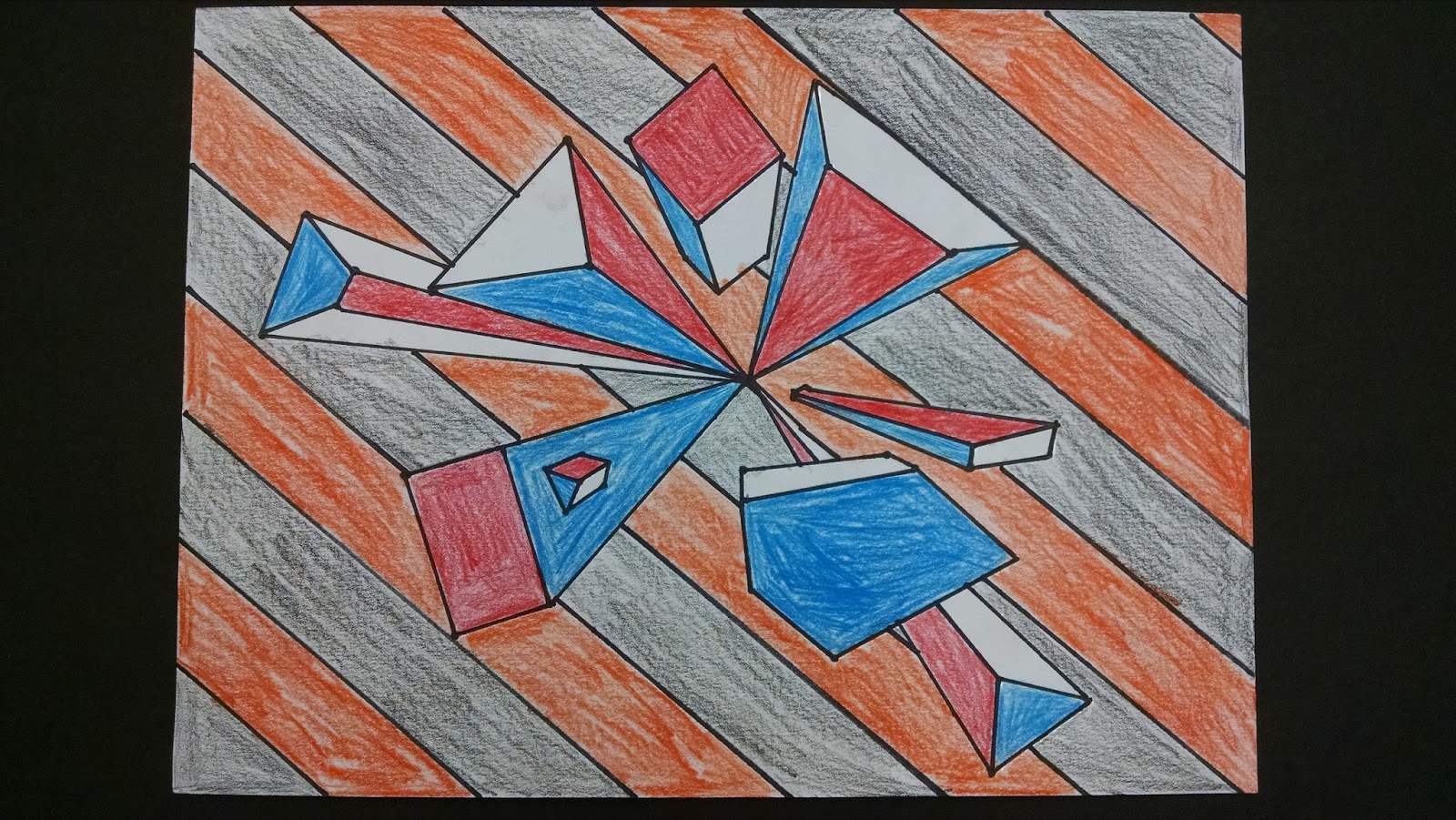
Featured Artists: Optical Illusion 2015 - one point perspective

 J.J. S.

 Caroline N.

 Adelaide E. 

 Colby L.

 Emily H.

 Zach T.

 Brian M.

 Mara S.

 Nikky P.

 Makaylin M.

 Liz L.

 Kyle V.

 Jade Y.

 Addison F.

 Colin M.

 Camden W.

 Josie G.

 Paige C.

 Jaydin K.

 Ryan U.

Nick W.