Sydney M.
Rose S.
Cole H.
Kendrah H.
Sarah M.
A great place to catch up on what we are doing in class and see some outstanding student artwork!
"Spring's Rebirth"
"Spring's Rebirth" 18"x30" Acrylic on Canvas 2016
Wednesday, May 9, 2012
Tuesday, May 8, 2012
Printmaking Autobiography Book Covers
Printmaking:
For the printmaking unit, students created a book cover for what would have been an autobiography. Obviously we did not have the time to write such a big book, but students contemplated their lives and came up with imagery that said something about themselves. Then students learned about printmaking. They did several proof prints experimenting with color and placement.
Then students brainstormed and creatively titled their autobiography. Next, students selected their best proof to add the title on using block letters or bubble letters. Finally, students used value to shade a variety of light and dark in their titles.
For the printmaking unit, students created a book cover for what would have been an autobiography. Obviously we did not have the time to write such a big book, but students contemplated their lives and came up with imagery that said something about themselves. Then students learned about printmaking. They did several proof prints experimenting with color and placement.
Then students brainstormed and creatively titled their autobiography. Next, students selected their best proof to add the title on using block letters or bubble letters. Finally, students used value to shade a variety of light and dark in their titles.
Monday, April 9, 2012
Tuesday, January 17, 2012
Featured Artists: Abstract Color Wheel
Greer S.
Cassie S.
Zoe A.
Christina Y.
Jodi D.
Anna C.
Hailey G.
Molly Y.
Derek Z.
Patrick B.
Hannah F.
Tristen F.
Color Unit
We have spent the whole 2nd marking period on the Color Unit consisting of 3 color based lessons.
Color Mixing: Students learned how to use the primary colors to mix secondary colors (orange, green, violet) and tertiary/intermediate colors (yellow-orange, red-orange, red-violet, blue-violet, blue-green, yellow-green). Students also learned how to mix tints and shades of any color, as well as how to use complimentary colors and their intensities.
Abstract Color Wheel: Students creatively designed an interesting expressive color wheel using their knowledge of color mixing to make all 12 colors of the color wheel (all primary, secondary, and tertiary colors). Then students learned about value and used the drawing techniques hatching and cross-hatching to fill the background with different values of light and dark.
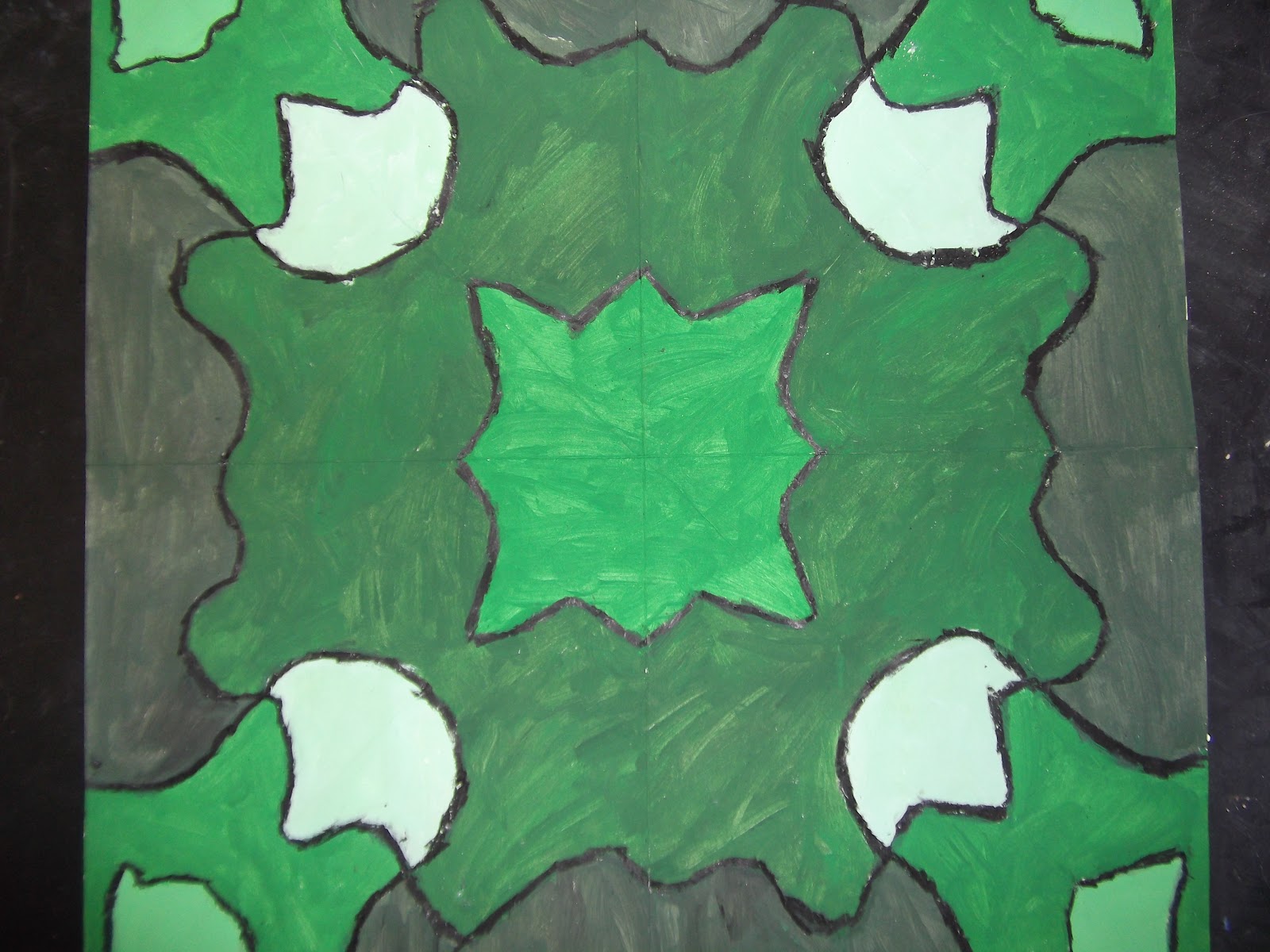
Color Scheme Painting: For the final culminating project, students drew a symmetrical radial design and choose one of three color schemes they learning about during the previous two lessons to paint their design. Students were able to choose a monochromatic, complimentary, or analogous color scheme for their final big painting. This truly allowed students the opportunity to show off their color mixing skills by applying the previous knowledge they learned to mix colors specific to the color scheme they selected. (Theses are my examples I used in class: Outline, monochromatic, complimentary, and analogous).

Color Mixing: Students learned how to use the primary colors to mix secondary colors (orange, green, violet) and tertiary/intermediate colors (yellow-orange, red-orange, red-violet, blue-violet, blue-green, yellow-green). Students also learned how to mix tints and shades of any color, as well as how to use complimentary colors and their intensities.
Abstract Color Wheel: Students creatively designed an interesting expressive color wheel using their knowledge of color mixing to make all 12 colors of the color wheel (all primary, secondary, and tertiary colors). Then students learned about value and used the drawing techniques hatching and cross-hatching to fill the background with different values of light and dark.
Color Scheme Painting: For the final culminating project, students drew a symmetrical radial design and choose one of three color schemes they learning about during the previous two lessons to paint their design. Students were able to choose a monochromatic, complimentary, or analogous color scheme for their final big painting. This truly allowed students the opportunity to show off their color mixing skills by applying the previous knowledge they learned to mix colors specific to the color scheme they selected. (Theses are my examples I used in class: Outline, monochromatic, complimentary, and analogous).
Saturday, November 19, 2011
One - Point Perspective
One - point perspective was a great way to start off learning for the year! We learned how to draw 3D shapes on a 2D drawing surface. We made an optical illusion by creating a sense of space and depth. All we needed to start was paper, a pencil, and a ruler.
Once we drew our 3D shapes, we added our names. Then we used color to help us improve our optical illusion. Using warm colors on the 3D shapes made the shapes "pop" out and separate from the background which was colored with a cool color pattern.
Here is an excellent student example of the one - point perspective optical illusion project by
Lovelynn Richards!
Subscribe to:
Comments (Atom)